Sunday, September 30, 2012

Kinetic photography


"...this type of photography uses motion heavily. There are a couple of techniques that fit the category of kinetic photography but all of them essentially use light and motion to create abstract shapes in the resulting photograph. The peculiar part is that, rather than utilizing a moving subject, most kinetic photographers instead opt to use camera motion to produce the desired effect."

Light Painting

Light Painting | Off Book | PBS

http://en.wikipedia.org/wiki/Light_painting
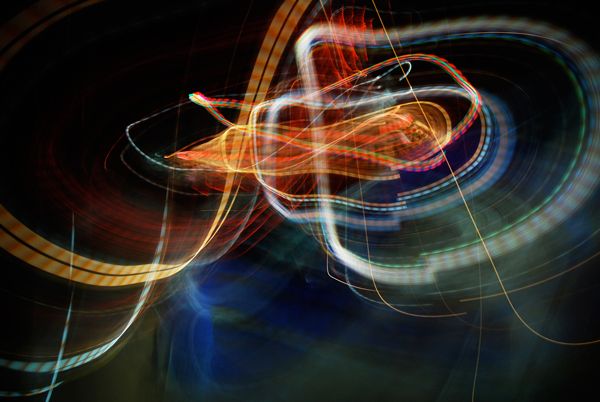
Light painting is a photographic technique in which exposures are made by moving a hand-held light source or by moving the camera. The term light painting also encompasses images lit from outside the frame with hand-held light sources.
http://lightpaintingphotography.com/light-painting-history/

Lytro Camera, Sugimoto, Femto-photography, and Comics

The Lytro Camera

http://www.lytro.com/science_inside


Contacts vol 2: Hiroshi Sugimoto


Ramesh Raskar: Imaging at a trillion frames per second

Ramesh Raskar presents femto-photography, a new type of imaging so fast it visualizes the world one trillion frames per second, so detailed it shows light itself in motion. This technology may someday be used to build cameras that can look “around” corners or see inside the body without X-rays.
Photography is about creating images by recording light. At the MIT media lab, professor Ramesh Raskar and his team members have invented a camera that can photograph light itself as it moves at, well, the speed of light.

Scott McCloud on comics

In this unmissable look at the magic of comics, Scott McCloud bends the presentation format into a cartoon-like experience, where colorful diversions whiz through childhood fascinations and imagined futures that our eyes can hear and touch. Scott McCloud is author of Understanding Comics, a comic book about comics. He's an evangelist for comics as a valid literary form (as more than pulp and kids' stuff) and his admiring fans include a laundry list of superstar cartoonists.

Thursday, September 27, 2012

Adenda P01

Foi acrescentado um pormenor à proposta de trabalho, pelo que passo a citar: "A narrativa deverá ter como base uma obra literária, áudio ou audiovisual (filme, videojogo, etc.). Poderá ainda ser criada de raíz, porém recomenda-se o anteriormente proposto."

Relembra-se que, para a aula de amanhã, os grupos já deverão estar devidamente formados e igualmente preparados para discutir e iniciar o seu projeto.

Bom trabalho a todos.

Sunday, September 23, 2012

P01: Imagem Fixa

O enunciado da proposta de trabalho 1 está disponível na respetiva página.

Relembra-se que para a próxima aula os grupos de trabalho já deverão estar devidamente formados. Cada grupo também já deverá ter escolhido a obra em que baseará o seu projeto, e, deste modo, deverão estar preparados para o produzir e discutir na aula.

Bom trabalho.

Friday, September 21, 2012

The Medium is the Massage


http://en.wikipedia.org/wiki/The_Medium_Is_The_Massage
The book itself is 160 pages in length and composed in an experimental, collage style with text superimposed on visual elements and vice versa. Some pages are printed backwards and are meant to be read in a mirror. Some are intentionally left blank. Most contain photographs and images both modern and historic, juxtaposed in startling ways.
http://en.wikipedia.org/wiki/Marshall_McLuhan
Herbert Marshall McLuhan, CC (July 21, 1911 – December 31, 1980) was a Canadian philosopher of communication theory. His work is viewed as one of the cornerstones of the study of media theory, as well as having practical applications in the advertising and television industries.
McLuhan is known for coining the expressions the medium is the message and the global village, and for predicting the World Wide Web almost thirty years before it was invented.
http://en.wikipedia.org/wiki/The_medium_is_the_message
"The medium is the message" is a phrase coined by Marshall McLuhan meaning that the form of a medium embeds itself in the message, creating a symbiotic relationship by which the medium influences how the message is perceived.
http://en.wikipedia.org/wiki/Quentin_Fiore
Quentin Fiore is noted especially by his designs of the 1960s, where he mixed text and images, different sizes of type and other unconventional devices to create dynamic pages that reflected the tumultuous spirit of the time. In the words of critic Steven Heller, Fiore was "as anarchic as possible while still working within the constraints of bookmaking".

Thursday, September 20, 2012

La Jetée


http://en.wikipedia.org/wiki/La_jet%C3%A9e

La jetée is a 1962 French science fiction featurette by Chris Marker. It is also known in English as The Jetty or The Pier. Constructed almost entirely from still photos, it tells the story of a post-nuclear war experiment in time travel. The film runs for 28 minutes and is in black and white. It won the Prix Jean Vigo for short film.

The 1995 science fiction film 12 Monkeys was inspired by, and takes several concepts directly from, La jetée.


http://en.wikipedia.org/wiki/Chris_Marker