I am sitting in a room different from the one you are in now. I am recording the sound of my speaking voice as well as the image of myself, and I am going to upload it to YouTube, rip it from YouTube, and upload it again and again, until the original characteristics of both my voice and my image are destroyed. What you will see and hear, then, are the artifacts inherent in the video codec of both YouTube and the mp4 format I convert it to on my computer. I regard this activity not so much as a demonstration of a digital fact, but more as a way to eliminate all human qualities my speech and image might have.At http://www.ontologist.us/post/?blogID=96.
Sunday, December 30, 2012
I Am Sitting In A Video Room

Skyence - INSCT
Collaboration between Skyence (Hamburg) and Johannes Timpernagel (Berlin).
Animation generated in VVVV, Editing in After Effects.
Direction & Animation: Johannes Timpernagel – http://www.timpernagel.com
Sound: Jochen Mader / Skyence / Audionerve – http://www.audionerve.de
For more Information about VVVV – http://vvvv.org
Do you like the track? Check out www.skyence.de !
At http://clayfolio.com/portfolio/?p=561.
Saturday, December 29, 2012
Evan Grant: Making sound visible through cymatics
"Evan Grant demonstrates the science and art of cymatics, a process for making soundwaves visible. Useful for analyzing complex sounds (like dolphin calls), it also makes complex and beautiful designs."
An Informal Catalogue of Slit-Scan Video Artworks and Research
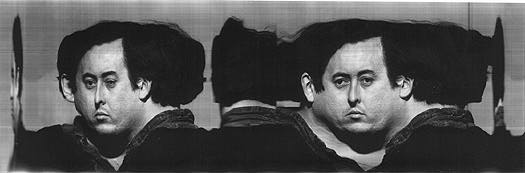
Slitscan imaging techniques are used to create static images of time-based phenomena. In traditional film photography, slit scan images are created by exposing film as it slides past a slit-shaped aperture. In the digital realm, thin slices are extracted from a sequence of video frames, and concatenated into a new image.At http://www.flong.com/texts/lists/slit_scan/.
Friday, December 28, 2012
Slit-scan photography

The slit-scan photography technique is a photographic and cinematographic process where a moveable slide, into which a slit has been cut, is inserted between the camera and the subject to be photographed.
At http://en.wikipedia.org/wiki/Slit-scan_photography.
Thursday, December 27, 2012
Efeitos Sonoros nos Filmes de Terror
A propósito do nosso trabalho na disciplina, resolvi postar
precisamente sobre os efeitos sonoros e as músicas dos filmes de terror, porque
são partes fundamentais dos mesmos. O medo, o pânico, desapareceriam se removessem
ou alterassem os efeitos auditivos com algo não condizente com o filme de
terror, e tal afirmação pode parecer exagerada, atendendo a que, teoricamente,
o meio visual já tem impacto suficiente para que seja perceptível a mensagem a
transmitir, mas na realidade, é fundamental também… Apresento um exemplo claro,
com o filme “Shining” (“O iluminado”), onde nos são apresentadas partes de
diversas cenas, mas com ideias muito distintas:
http://www.youtube.com/watch?v=sfout_rgPSA
http://www.youtube.com/watch?NR=1&v=5Cb3ik6zP2I&feature=fvwp
no primeiro caso, é-nos apresentada uma comédia, um filme
sugestivo a ver em família; mas depois, vemos o trailer do filme, e descobrimos
que de humor não tem nada, é um filme de terror, mais intenso do que alegre,
mais arrepiante que divertido…
Geralmente, a música orquestral é o tipo mais característico
de música utilizada nos filmes de terror: tem sido usada desde o nascimento do género
e, até hoje, é o mais popular tipo de música usada para estes filmes, talvez
porque a sua dinâmica permite ao compositor variar, fazer as suas composições
acompanharem os eventos do filme, mas também, e possivelmente a principal
razão, a música orquestral é poderosa e funciona bastante bem quando é
necessário transmitir emoções ao telespectador.
Claro que não é o único género musical usado para filmes de
terror, muitos filmes actuais utilizam também o rock ou música industrial, e um
bom exemplo deste conceito é o filme “Blair Witch 2”, que usa o rock
alternativo e o metal, por exemplo:
http://www.youtube.com/watch?v=4gbvjHb0ZUA&feature=BFa&list=PL2095A62BF3B457BD
Alguns cineastas, porém, decidem inovar, digamos assim, e
acabam por escolher um leque de músicas tão diferente para os seus filmes de
terror que, à partida, nunca seriam sequer opções… E talvez, o caso mais
extremo seja no filme “American Psycho”:
neste filme, torna-se óbvia a necessidade do tipo certo de
música nos filmes de terror, para que realmente possa funcionar bem. A cena
acima, transmite um sentimento muito estranho quando Patrick Bateman (o
protagonista masculino- Christian Bale) mata uma das suas vítimas ao som de
“Hip to be Square” de “Huey Lewis and the News” - o efeito produzido é uma dissonância
audio-visual enorme, porém enquanto a música diminui o factor medo desta cena
em particular, acaba por criar uma experiência muito estranha (quase surreal),
que deve ser provavelmente o que os produtores do filme queriam criar.
Alguns casos ainda nos filmes de terror é quando a música tem
uma relação directa com os movimentos da personagem aumentando assim a sua
intensidade, este método é chamado “Mickey-Mousing” (termo inspirado nos
primeiros filmes da Walt Disney, os quais a música era praticamente uma mímica
às animações), porém, actualmente já não é muito utilizado. Foi aplicado em
King-Kong (1933), e mais recentemente podemos ver em alguns dos filmes da saga
“Sexta-Feira 13”, realçando os momentos em que Jason (o assassino) ataca as
suas vítimas, como se observa bem nesta cena:
Em muitos filmes de terror, é criado um símbolo sonoro, isto
é, há um efeito sonoro que serve para criar uma maior relação entre os aspectos
sonoros e visuais com o “mau da fita”, ou seja, para os espectadores, é
possível reconhecer o ‘monstro’ apenas através do som, sem ser preciso vê-lo.
Esta técnica é mais comum em filmes com muitas sequências porque este tipo de
vínculo demora a ser estabelecido. No filme nos quais nos baseamos – Silent
Hill - podemos considerar a sirene o tal símbolo, a relação entre a escuridão
que se aproxima, o dito "monstro”.
Monday, December 24, 2012
Marina Abramovic no Smithsonian's
Como prenda de Natal, fica uma conferência desta artista sobre Video Art e Performance, a sua interação com a Escultura e com o Corpo Humano.
Achei bastante interessante apesar de ser longo, mas vale bastante a pena porque não só nos dá todo um novo leque de referências como pode dar-vos várias ideias.
http://www.youtube.com/watch?v=Abk44swuaro
Achei bastante interessante apesar de ser longo, mas vale bastante a pena porque não só nos dá todo um novo leque de referências como pode dar-vos várias ideias.
http://www.youtube.com/watch?v=Abk44swuaro
Saturday, December 22, 2012
Friday, December 21, 2012
Generative music in Supercollider & Processing
Deixo aqui uma série de efeitos que foram feitos através de linguagens audio programming. Para aqueles que não sabem programar acho que pelo menos vos pode dar algumas ideias que podem inserir no trabalho de uma outra forma. ^^
Espero ter ajudado!
Sorrisos,
Alexandra
Wednesday, December 19, 2012
Cymatics - Bringing Matter To Life With Sound
Isto é tipo um documentário sobre Cymatics, pode ser útil para além...
Parte 1
Parte 2
Parte 3
Parte 1
Parte 2
Parte 3
Flatten
Uma experiência interessante e muito bem executada.
"An experimental film in which we where curious about the forms and shapes food makes when you flatten them.
After that we composited different parts of the video and each gave them a separate time span so we could edit on the music.
We are open for suggestions for screenings on festival, exhibitions, museums or other publications.
2012, June 28 – HKU Mediale- First price( jury award) – Hilversum, Netherlands
Concept & Visuals : Hugo de Kok & Kay van Vree
Music : Ivo van Dijk & Sophie Ansems"
Music : Ivo van Dijk & Sophie Ansems"
Monday, December 17, 2012
Sunday, December 16, 2012
Hyundai Vision Hall
"And so to South Korea where Universal Everything were commissioned to create a series of videos for the hyundai Vision Hall. Utilising the 24 metre wide and 36 channel surround sound, Matt Pyke and his team produced an interesting set of works."
Saturday, December 15, 2012
Friday, December 14, 2012
NOTIFICAÇÃO
Serve o presente post para fazer o seguinte apelo. A vossa colega Alexandra Cardoso não conseguiu até agora formar ou agregar-se a um grupo de trabalho. Uma vez que a Alexandra frequenta esta unidade curricular como estudante de mobilidade interna, certamente sente mais dificuldade nesta simples tarefa.
Deste modo, apela-se aos grupos já formados que ponderem em agregar a Alexandra com a maior brevidade. Para esse o efeito deixo o seu endereço de email através do qual espero que a contactem: jp.crai@hotmail.com. Peço que enderecem o email para mim também, por favor.
Conto com a vossa colaboração.
Bom trabalho,
Pedro Cardoso.
Deste modo, apela-se aos grupos já formados que ponderem em agregar a Alexandra com a maior brevidade. Para esse o efeito deixo o seu endereço de email através do qual espero que a contactem: jp.crai@hotmail.com. Peço que enderecem o email para mim também, por favor.
Conto com a vossa colaboração.
Bom trabalho,
Pedro Cardoso.
Cymatic Music


No meio das minhas pesquisas encontrei este site que julgo ser interessante para o próximo trabalho. O site tem muita teoria o que nos dá as bases do Cymatics (para aqueles que precisam de ter uma razão para conseguir trabalhar em algo, como eu) e fala mesmo de algumas experiências já feitas (o que é preciso para se fazer e que resultados podemos obter).
Espero que vos seja útil!
Sorrisos,
Alexandra
Thursday, December 13, 2012
Ferroux
Tuesday, December 11, 2012
Monday, December 10, 2012


Saturday, December 8, 2012
Dub Video Connection
Dub Video Connection é um estúdio com sede em Lisboa que trabalha diversas áreas ligadas ao design e multimédia, entre elas o video mapping e o 3d, criando narrativas visuais muito interessantes.
Friday, December 7, 2012
XX - Angels
Penso que vai de encontro a esta última aula.
Projection mapping
MULTIMEDIA SPECTACLE AT LA SAGRADA FAMILIA, BARCELONA
September 21, 22 & 23, 2012
Creation and Direction : Moment Factory
Original idea : RENAUD - Architecture d’événements
In collaboration with : La Ville de Montréal, Tourisme Montréal, La Ville de Barcelone, La Mercè
Thursday, December 6, 2012
Re: Niklas Roy's Lumenoise, VVAA

Colönia invites you to the opening of Re: Lumenoise — a reinterpretation of Niklas Roy's Lumenoise, next Saturday the 8th of December at 5pm.
Lumenoise, a light pen audiovisual synthesizer that interacts with analogue TV screens, was developed by Niklas Roy during a highspeed residency at La Gaîté Lyrique, a multi-purpose space for digital art and new media, in Paris.

The german artist, whose work we've been following for a while, makes available for download through his website the piece's code and schematics in order to allow the general public to build their on versions of Lumenoise.
As a way to highlight this act of sharing and active dialogue with the public domain, Colönia commissioned a couple of reinterpretations of Lumenoise coordinated by Ricardo Lafuente, and developed by two teams of Communication Design students from the University of Porto Fine-Arts School.
Therefore, the Colönia Micro-gallery is delighted to present Re: Niklas Roy's Lumenoise, by Maura Carvalho & Tomás Canha and Joana Morgado, Hugo Lobo & Raquel Meireles, with Ricardo Lafuente.
The exhibition runs from the 8th of December until the 1st of March. You can visit the Colönia Micro-gallery from Tuesday to Friday, 14-19H30, and Saturdays 14-19H.
http://colonia.pt/newsletter/newsletter_re-lumenoise-en.html
http://colonia.pt/newsletter/newsletter_re-lumenoise-pt.html
Where is Colönia? -> http://colonia.pt/index.php?/contact/
3Destruct
3DESTRUCT / Scopitone 2011 from Yannick Jacquet (Legoman) on Vimeo.
Instalação audiovisual
Scopitone Festival / Le Lieu Unique / Nantes / France
Outubro 2011
Outubro 2011
YANNICK JACQUET
JEREMIE PEETERS
JEREMIE PEETERS
Áudio:
THOMAS VAQUIE
THOMAS VAQUIE
Wednesday, December 5, 2012
Sinopse/mind map
Para a próxima aula todos os grupos deverão produzir uma pequena sinopse ou um mapa mental relativo à proposta de trabalho 3, que deverá também incluir os nomes dos membros do grupo, e as duas citações seleccionadas (com autor, obra e página).
Este documento deverá ser apresentado durante a discussão do projeto, e enviado por email até ao fim da respectiva aula.
Bom trabalho.
Este documento deverá ser apresentado durante a discussão do projeto, e enviado por email até ao fim da respectiva aula.
Bom trabalho.
Tuesday, December 4, 2012
Sequelitis : Mega Man Classic vs. Mega Man X
Este video não dá para incorporar, mas se estiverem interessados fala sobre o videojogo Mega Man, as mecânicas do jogo e como estas evoluíram mais tarde.
Também ajuda a perceber um bocado a "teoria" que pode haver por trás do design de um jogo.
Clicar aqui para ver o vídeo
Sunday, December 2, 2012
To understande is to perceive patterns
TO UNDERSTAND IS TO PERCEIVE PATTERNS
A abordagem deste tema é bastante interessante mas a par dela gostei especialmente da ligação entre som e imagem. A sensação frenética presente na apresentação das imagens adequa-se plenamente à impulsividade de como o locutor se exprime em todo o video.
A abordagem deste tema é bastante interessante mas a par dela gostei especialmente da ligação entre som e imagem. A sensação frenética presente na apresentação das imagens adequa-se plenamente à impulsividade de como o locutor se exprime em todo o video.
Saturday, December 1, 2012
Fantastic 3D Sound Experience Virtual Haircut
É velhinho mas sempre lhe achei piada, basta por os auscultadores e fechar os olhos por uns 5 minutos, vale a pena!
Thursday, November 29, 2012
Doppler effect
The Doppler effect (or Doppler shift), named after the Austrian physicist Christian Doppler, who proposed it in 1842 in Prague, is the change in frequency of a wave (or other periodic event) for an observer moving relative to its source. It is commonly heard when a vehicle sounding a siren or horn approaches, passes, and recedes from an observer. The received frequency is higher (compared to the emitted frequency) during the approach, it is identical at the instant of passing by, and it is lower during the recession.
Physics of sound
Program: Nature of Things with David Suzuki.
Chapter: Voices in the wind.
Topic: Physics of sound.
Tuesday, November 27, 2012
Quodlibet
Emmanuel Nunes, compositor português. "Ao longo da sua obra três elementos emergem como referências fundamentais: a reflexão sobre o tempo, a atenção dada ao espaço, e a ideia omnipresente de intencionalidade, tanto da escuta como da composição."
acoustic levitation
Se quiserem aprender mais, aqui fica: http://www.anl.gov/articles/no-magic-show-real-world-levitation-inspire-better-pharmaceuticals
Your Face
Bill Plymton curta "For this one, he contacted Maureen McElheron, an old friend with whom he had performed in a Country Western Band (he played pedal steel guitar), and she agreed to score "Your Face." Due to budgetary considerations, she also sang. Her voice, eerily decelerated to sound more masculine, combined with a fantastically contorting visage helped garner the film a 1988 Oscar nomination for best animated short."
Instalações Sonoras Zimoun
Deixo-vos com um video do trabalho do artista Zimoun.
http://vimeo.com/32012831
Monday, November 26, 2012
Atendimento
Informo todos os alunos que esta quarta-feira à tarde (28/11) estarei disponível para atendimento mediante marcação prévia por email.
Sunday, November 25, 2012
Saturday, November 24, 2012
Sampled Room
"This is an example, how to use the basic stuff in your room in such creative and musician way. Just take some noisy and voiced objects and record them with any sampler."
Friday, November 23, 2012
Thursday, November 22, 2012
Wednesday, November 21, 2012
"The Future of Music: Credo" by John Cage
Most inventors of electrical musical instruments have attempted to imitate eighteenth- and nineteenth- century instruments, just as early automobile designers copied the carriage. The Novachord and the Solovox are examples of this desire to imitate the past rather than construct the future. When Theremin provided an instrument with genuinely new possibilities, Thereministes did their utmost to make the instrument sound like some old instrument, giving It a sickeningly sweet vibrato, and performing upon it, with difficulty, masterpieces from the past. Although the instrument is capable of a wide variety of sound qualities, obtained by the turning of a dial, Thereministes act as censors, giving the public those sounds they think the public will like. We are shielded from new sound experiences.At http://helios.hampshire.edu/~hacu123/papers/cage.html
Tuesday, November 20, 2012
Beatsurfing - The Organic MIDI Controller Builder - Official Teaser
BEATSURFING - THE ORGANIC MIDI CONTROLLER BUILDER
beatsurfing.net
beatsurfing.net
It allows you to draw a 3-dimensional controller and use it in two different and complementary ways. You can tap it like you would with your regular MPC or any other beatmaking device, but the best and most innovative use you can make of it is definitely by surfing your fingers along routes, colliding with objects, triggering samples or effects. It’s all about movement, and bringing back this intuitive way to make music.
It can control any MIDI-enabled device (Software, Hardware, or even selected iPad apps through Virtual MIDI), features a very intuitive in-app editing system and integrates seemlessly in any existing Studio or Live setup.
Objects Behaviours can be set to link objects together and multiply the available commands on the surface of the iPad.
Monster Tubulum
Time to Start (the first cut) was the first video I uploaded here - other than the ever-popular tubulum head layout animation - and has since become a clear favourite on this channel. It recently celebrated its 1000th view.
In honour of this milestone, I resolved to create a version of Time to Start actually worthy of being the most popular video on this channel.
So here it is, complete with 37 cuts and an extended intermission, for your entertainment. (it's just one of those things so terribly long you can't help but watch, hoping something will happen).
P.P.S. Yeah, that's actually me playing the audio. I built a frickin' monster tubulum, what reason could I possibly have not to use it?
--Jerry
The Aquasonic Waterphone
http://www.thomasgrillo.com
Originally invented by Richard Waters, the waterphone contains a small amount of water which moves around inside the waterphone, and causes constant changes in pitch.
This particular waterphone was produced by a metal sculptor in New York City under the brand name "Aquasonic". It can now be purchased at:http://www.thewaterphone.com/ as well as http://gallery93.com/
We correctly call it the "waterphone" as the name rightfully reflects the name of it's original inventor, Richard Waters, and the fact that it uses water to help produce the strange etherial tones.
Watch as Thomas Grillo endures one minor technical difficulty after another as he attempts to demonstrate the Aquasonic Super Mondo Waterphone.
Originally invented by Richard Waters, the waterphone contains a small amount of water which moves around inside the waterphone, and causes constant changes in pitch.
This particular waterphone was produced by a metal sculptor in New York City under the brand name "Aquasonic". It can now be purchased at:http://www.thewaterphone.com/ as well as http://gallery93.com/
We correctly call it the "waterphone" as the name rightfully reflects the name of it's original inventor, Richard Waters, and the fact that it uses water to help produce the strange etherial tones.
Watch as Thomas Grillo endures one minor technical difficulty after another as he attempts to demonstrate the Aquasonic Super Mondo Waterphone.
Screen Capture to Sound – by Satoru Higa
Some time ago Zach Lieberman posted code on the oF forums which allows you to show the pixels directly below the openFrameworks app window in a texture. This little app Satoru Higa (4nchor5 la6/rhizomatiks) uses the same method to create a music sequencer. Each time app is ran, the transparent window uses the desktop as the source for sound. The colour and the position of the colours below decides the pitch, tone and tempo. As you drag the window around the desktop or add additional ones you can further create compositions.At http://www.creativeapplications.net/sound/capture-to-sound-by-satoru-higa/

Sunday, November 18, 2012
Saturday, November 17, 2012
Friday, November 16, 2012
Prazos P02
Conforme anunciado na aula de hoje, os prazos da proposta de trabalho 2 ficam adiados para:
- Entrega da memória descritiva: 29/11/2012, 19:00.
- Apresentação: 30/11/2012, 9:30 AM—turma 1; e 14:00—turma 2.

Como seria um clipe sem o instrumental?
Um usuário do YouTube imaginou como seria o clipe de Gangnam Style sem o instrumental da música, editado com o áudio ambiente nos locais da gravação, fez a montagem e divulgou em seu canal.
Como seria o clipe de Gangnam Style sem o instrumental?
Como seria o clipe de Gangnam Style sem o instrumental?
Learn to Listen
Aqui está um vídeo, do qual o som foi captado meticulosamente. Ouve-se perfeitamente o respirar e as pingas de água.
Wednesday, November 14, 2012
"The Three Listening Modes" by Michel Chion
When we ask someone to speak about what they have heard, their answers are striking for the heterogeneity of levels of hearing to which they refer. This is because there are at least three modes of listening, each of which addresses different objects. We shall call them causal listening, semantic listening, and reduced listening.At http://helios.hampshire.edu/~hacu123/papers/chion.html.
Tuesday, November 13, 2012
Vocaloid
 |
| Imagem retirada do http://http://shinigamipower.blogspot.pt |
Quando comecei a conhecer o mundo do design fiz parte de um projeto, a FOP Magazine, para a qual escrevi um artigo sobre Vocaloid. Achei que era interessante mostrar-vos já que neste momento estamos a dar o módulo de som e as variadas formas de o criar. Convém referir que o importante é o conteúdo do artigo já que o design é bastante rudimentar e a forma de escrita pode não ser a melhor.
Podem ler o respetivo artigo aqui.
Monday, November 12, 2012
Células de lula que reagem ao som
"Chromatophores are muscle-controlled pigment cells in the skin of cephalopods, such as squid, octopus, and cuttlefish. These chromatophores expand and contract on command in order to help the animal blend in with its surroundings, or to communicate with other animals."
Pachelbel - Canon in D
Cypress Hill - Insane in the Brain
Einstein on the Beach de Philip Glass
Como os efeitos sonoros são feitos
Estes videos mostram como os efeitos sonoros são produzidos e gravados para um filme. O interessante é que alguns sons são feitos com objectos que eu nunca imaginaria...
Este tambem é interessante, mas não dava para incorporar, por isso deixo-vos com o link:
http://www.youtube.com/watch?v=DKDjLseCyVw
Este tambem é interessante, mas não dava para incorporar, por isso deixo-vos com o link:
http://www.youtube.com/watch?v=DKDjLseCyVw
Friday, November 9, 2012
Livio Minafra
Livio Minafra
Assisti a um concerto deste compositor e pianista, no festival 12 points apresentado na Casa da Música.
Durante os concertos, Livio Minafra vai colocando objectos dentro do piano que alteram o som das notas. Para além disso, acrescenta outros métodos menos convencionais à sua música.
Virtual Barber Shop
You'll need headphones for this to work. Make sure there is no noise around, close your eyes, turn the volume up a little bit, hold and press headphone on your ears for better hearing, play it and enjoy this impressive audio work.
CREDITS: This amazing audio clip was created by QSound Labs ( http://www.qsound.com ) as a demonstration of Binaural audio technology.
See this wikipedia entry for information about binaural recordings.
http://en.wikipedia.org/wiki/Binaural_recording
LOOM
Loom from Polynoid on Vimeo.
Loom tells the story of a successful catch.
Year: 2010Length: 5'20"
Directors: Jan Bitzer, Ilija Brunck, Csaba Letay
Technical director: Fabian Pross
Production company: Filmakademie BW
Producer: Regina Welker
Sound: Joel Corelitz / waveplant
Artists:Felix Mertikat, Jin-Ho Jeon, Roman Kälin, Tom Weber, Christian Hertwig, Silke Finger, Jacob Frey, Leszek Plichta, Georg Schneider, Anja Wacker, Andreas 'Felix' Gebhardt, Falko Paeper, Sarah Eim
5.1 Mix: David Axelbaum / Airstream Audio
Unnamed Soundsculpture
o que interessa, neste caso, é o som produzido: uma mistura de explosões com o rebentar daquelas bolhinhas dos plásticos que revestem os vidros, que depois se enquadra com o instrumento, aumentando o carácter enigmático do som.
O nome do vídeo também não é por acaso, já que a próprio câmara também reagia ao som.
O conceito do projecto, está explicado aqui:
The basic idea of the project is built upon the consideration of creating
a moving sculpture from the recorded motion data of a real person. For
our work we asked a dancer to visualize a musical piece (Kreukeltape by
Machinenfabriek) as closely as possible by movements of her body. She was
recorded by three depth cameras (Kinect), in which the intersection of the
images was later put together to a three-dimensional volume (3d point cloud),
so we were able to use the collected data throughout the further process.
The three-dimensional image allowed us a completely free handling of the
digital camera, without limitations of the perspective. The camera also reacts
to the sound and supports the physical imitation of the musical piece by the
performer. She moves to a noise field, where a simple modification of the
random seed can consistently create new versions of the video, each offering
a different composition of the recorded performance. The multi-dimensionality
of the sound sculpture is already contained in every movement of the dancer,
as the camera footage allows any imaginable perspective.
texto de Sandra Moskova,
projecto de Daniel Franke e Cedric Kiefer
a moving sculpture from the recorded motion data of a real person. For
our work we asked a dancer to visualize a musical piece (Kreukeltape by
Machinenfabriek) as closely as possible by movements of her body. She was
recorded by three depth cameras (Kinect), in which the intersection of the
images was later put together to a three-dimensional volume (3d point cloud),
so we were able to use the collected data throughout the further process.
The three-dimensional image allowed us a completely free handling of the
digital camera, without limitations of the perspective. The camera also reacts
to the sound and supports the physical imitation of the musical piece by the
performer. She moves to a noise field, where a simple modification of the
random seed can consistently create new versions of the video, each offering
a different composition of the recorded performance. The multi-dimensionality
of the sound sculpture is already contained in every movement of the dancer,
as the camera footage allows any imaginable perspective.
texto de Sandra Moskova,
projecto de Daniel Franke e Cedric Kiefer
VISUAL MUSIC FOR10VOICES
In Barthes' essay, "The Grain of the Voice", the concept of the
"genosong" was evoked to separate the sound of the voice from its
language. Visual Music for Ten Voices distinguishes the physicality of
the optical vocal track as having a unique identity from its actual
resonance in sound films. Designed as a 10-foot black box projection
loop, this film focuses on the rhythm and materiality of ten 35mm
optical soundtracks. Each musical passage maintains its original length
and linear harmony with the other tracks, collectively creating a new
sense of motion and repetition.
Thursday, November 8, 2012
Embedding a YouTube Video
To embed a video from YouTube, just follow these simple steps:
1 - Click on the "Share" button underneath the YouTube video.
2 - Select "Show more," and then click on the Blogger icon.
3 - Depending on whether or not you're signed in to your blog, you might have to enter in your username and password in the new window that pops up.
4 - At the top of the new window, choose the blog you would like to post to from the drop-down menu.
5 - Publish your post!
Alternatively, you can copy the embed code and paste it into your blog.
1 - Just click on "Share" and then on "Embed" to find the embed code.At http://support.google.com/blogger/bin/answer.py?hl=en&answer=80767
2 - Copy the code, then paste it into your blog while on the "Edit HTML" tab (as opposed to the "Compose" tab).

Scott Cazan
"Scott Cazan is a performer/composer and sound artist specializing in the performance of experimental electronic music where he explores human relations with technology, the act of listening and the physicality of sound." http://scottcazan.net/index.php/works
Cidade de Braga
Este vídeo consiste numa pequena apresentação da cidade de Braga, que por sinal é Capital Europeia da Juventude.
http://vimeo.com/45683390
http://vimeo.com/45683390
Wednesday, November 7, 2012
Soundscape
A soundscape is a sound or combination of sounds that forms or arises from an immersive environment. The study of soundscape is the subject of acoustic ecology. The idea of soundscape refers to both the natural acoustic environment, consisting of natural sounds, including animal vocalizations and, for instance, the sounds of weather and other natural elements; and environmental sounds created by humans, through musical composition, sound design, and other ordinary human activities including conversation, work, and sounds of mechanical origin resulting from use of industrial technology. The disruption of these acoustic environments results in noise pollution.
The term "soundscape" can also refer to an audio recording or performance of sounds that create the sensation of experiencing a particular acoustic environment, or compositions created using the found sounds of an acoustic environment, either exclusively or in conjunction with musical performances.
At http://en.wikipedia.org/wiki/Soundscape and http://www.sfu.ca/sonic-studio/handbook/Soundscape.html
Noise rock, avant-garde
The work consists of two side-long pastiches of various songs from the period. The liner notes state that approximately 30 songs have been utilised. Some are obvious, while others are almost unrecognizable.
- Tons puros - compostos por uma única frequência. É o caso mais simples;
- Sons musicais - compostos por uma frequência fundamental (que dá a tonalidade) e várias frequências de valor múltiplo inteiro da fundamental (harmónicas), dependendo do timbre. É o caso dos sinais de voz;
- Ruído - composto por inúmeras frequências sem que exista um padrão que as relacione directamente. O resultado é um sinal complexo, sem uma frequência fundamental fixa, sendo portanto um sinal não periódico. Estes sinais têm um comportamento imprevisível e, consequentemente, são difíceis de caracterizar com exactidão.
Tuesday, November 6, 2012
Subscribe to:
Posts (Atom)